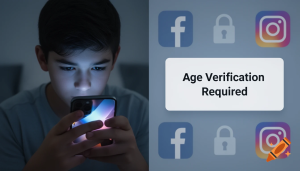
Age verification has become one of the most contested policy tools in the digital world. Governments, regulators and platforms present it as a necessary step to protect children from harm. Critics warn it opens the door to surveillance, data misuse and a creeping normalisation of identity checks in everyday online life. Both sides are reacting to real risks.
This blog looks directly at the pros and cons of age verification, including the fears about “Big Brother” and Orwellian futures, and what is actually grounded in evidence.
What age verification is trying to solve
The stated goal is simple. Prevent children from accessing harmful or inappropriate content and services online. This includes explicit material, gambling, alcohol sales, certain social media features, and spaces where exploitation or abuse risk is higher.
Most systems fall into one of three types:
• Document based checks such as passports or driving licences
• Biometric estimation such as face age estimation tools
• Behaviour or account history signals that infer age
Each comes with different levels of accuracy, privacy impact and ease of use.
The clear benefits
The strongest argument for age verification is child protection. There is consistent evidence that children encounter content and contact online that is not suitable for their age. Properly implemented age controls can reduce accidental exposure to harmful material and create safer environments for younger users.
Another benefit is regulatory clarity. Platforms and retailers can demonstrate that they are taking reasonable steps to meet legal obligations. This matters for areas like online gambling, alcohol sales and adult content where age limits already exist offline.
There is also a public confidence argument. Many parents expect guardrails. Age verification signals that companies are taking safety seriously rather than leaving responsibility entirely to families.
Finally, there is a deterrence effect. Some bad actors rely on anonymity and ease of access. Requiring proof of age or identity can raise friction for those attempting to exploit minors or operate in illegal markets.
The real drawbacks and risks
Privacy is the most obvious concern. Many systems require users to upload identity documents or submit biometric data. Even when processed by third party providers, this creates new data flows and potential points of failure. Breaches, misuse or function creep are legitimate risks.
Data minimisation is not always well implemented. In some cases, more data is collected than strictly necessary to answer a simple question; namely is this user above or below a threshold age.
There is also an inclusion problem. Not everyone has a passport or driving licence. Young adults, migrants, people with unstable housing and those who avoid formal ID for safety reasons can be excluded or face barriers.
Accuracy is uneven. Face age estimation tools can perform differently across skin tones and ages, with higher error rates at the boundaries. False positives can block adults. False negatives can allow minors through.
Then there is the normalisation effect. Once people become used to proving identity to access ordinary online spaces, it becomes easier for that requirement to expand into new areas.
The “Big Brother” and Orwell question
The fear of a surveillance society is often framed through the lens of Nineteen Eighty-Four by George Orwell. The concern is not just about one tool, but about trajectory. If age verification becomes a default gateway to online life, it could enable persistent tracking of individuals across services, although I believe that this has been in place for many years already so the horse has already bolted.
There are three specific worries behind the rhetoric:
First, linkage. If identity checks are tied to persistent identifiers, activity across sites can be correlated.
Second, retention. If providers store verification data longer than necessary, it increases exposure in the event of misuse or breach.
Third, scope creep. Systems introduced for child safety could be extended to political speech, news access or general browsing.
These are not imaginary risks. They depend on design choices, legal safeguards and enforcement. The same mechanism can be privacy preserving or intrusive depending on how it is built and governed.
What good implementation looks like
A proportionate system focuses on the minimum information needed to answer the question. For many use cases, this is a simple “over or under” check, not full identity disclosure.
Key principles used by privacy and security professionals include:
Data minimisation. Collect only what is needed and delete it promptly after the check.
Separation. Keep verification providers separate from the service being accessed so no single party sees both identity and activity.
Tokenisation. Use anonymous or one time tokens to confirm age status without revealing identity.
Local processing. Where possible, perform checks on device so sensitive data does not leave the user’s control.
Independent oversight. Require audits, transparency reports and enforceable penalties for misuse.
Accessibility. Provide multiple routes to verification so people without standard ID are not excluded.
Short retention. Store nothing or store for the shortest period necessary with strict deletion policies.
Where the balance usually lands
In practice, most countries that introduce age verification try to strike a balance. They target specific high risk services first, set standards for privacy preserving methods, and phase in requirements rather than applying them universally.
The debate is not going away. Technology will continue to evolve, and so will expectations about safety and privacy. The sensible middle ground is to treat age verification as a narrow tool for specific risks, not a general identity layer for the whole internet.
The bottom line
Age verification can reduce harm and increase accountability when used in the right places and designed with privacy at its core. It can also create new risks if implemented broadly or carelessly.
The difference between a protective measure and an intrusive system is not the concept itself but the safeguards around it. Clear limits, minimal data use, independent oversight and genuine alternatives for users determine whether it remains a targeted safety control or drifts toward something more troubling.
Perhaps what we need is a simple “ticket to the internet”, something as straightforward as a cinema ticket that grants access without exposing more than necessary. It is worth remembering that long before our online lives took off, political parties were already able to send letters to people on their eighteenth birthday, addressed correctly and without fuss. In that sense, a form of “Big Brother” has existed far longer than many people realise.
Yes, documents can be forged. That has always been true. We still rely on passports and bank cards because the systems around them include checks, renewal cycles and fraud controls that make them workable for everyday use. The same principle would apply to an online “ticket”. It would need clear expiry, cancellation when someone dies, and a way to revoke and reissue when there is misuse.
There would be a cost. If that cost also covered basic digital training, safety awareness and the tools needed to use services securely, it could shift how people view it. It becomes not just a barrier but a package of access and competence, with a clear standard for what safe participation online looks like.
On whether this type of permit would feel better to use, the answer depends on the design. If it is minimal, time limited, independently overseen and does not track what people do online, it would feel closer to a simple access pass. If it collects more data than needed or is linked across services, it would feel intrusive, especially if this was mandated. The sense of comfort comes from strict limits, transparency and enforcement around how it operates.
References
UK Information Commissioner’s Office guidance on age appropriate design and data minimisation
Ofcom policy statements on online safety and age assurance
European Data Protection Board opinions on age verification and privacy
NIST Digital Identity Guidelines
Academic reviews on facial age estimation accuracy and bias
Child safety research from NSPCC and Internet Watch Foundation
Legal analyses of online age verification frameworks in the UK and EU