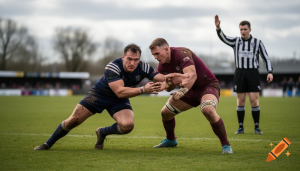
There is a particular stillness that arrives at the end of a match in the Six Nations Championship. It doesn’t arrive with the roar of the crowd, nor with a referee’s final whistle cutting through eighty minutes of physical intensity. The noise is still there, of course. Scarves lifted, flags waving, songs half-finished in the stands. But beneath it, something softer settles across the pitch. Hands rest on hips, players who moments before were colliding like weather systems now walk quietly across the grass, nodding to one another, exchanging a word, a handshake, sometimes an embrace that lasts a second longer than expected. The match is over, but the meaning of it lingers for a long while thereafter…
Elite sport has a curious way of distilling life into its simplest form. Strip away the commentary, the pundits, the endless statistics, and what remains are a few enduring truths that reveal themselves every time the game is played at the very highest level.
The first is the quiet power of effort. Not effort as a slogan, but effort as a daily discipline. The kind that begins long before a stadium fills. The unseen hours in cold training fields when nobody is watching. The repetition of drills that look almost dull to an outsider but which slowly build the muscle memory that allows something extraordinary to happen under pressure. A pass thrown instinctively under floodlights on a Saturday afternoon was rehearsed hundreds of times on an empty Tuesday morning at Marcoussis.
The world often celebrates the moment of brilliance. A try in the corner. A break through the line. A perfect kick sailing between the posts. But elite sport teaches us that brilliance is rarely spontaneous. It is usually the final brushstroke on a canvas painted slowly, patiently, over years.
The second lesson arrives in the form of humility. Rugby, perhaps more than many sports, refuses to allow anyone to believe their own myth for too long. Champions fall. underdogs rise – a bit like the Lions team has done this year. A team that looks invincible one weekend can find itself humbled the next.
The scoreboard has a wonderful honesty to it. It does not care about reputation or headlines. It only reflects what happened between the first whistle and the last. Players know this better than anyone. That is why the handshake line after a match carries such weight. It is not a ritual of politeness, but also recognition. A shared understanding that everyone out there has endured the same collisions, the same exhaustion, the same quiet test of character.
Victory is respected, but never assumed. Defeat is accepted, but never allowed to define. In this way, elite sport becomes one of life’s more elegant teachers. It reminds us that success is something you visit briefly rather than somewhere you permanently reside.
And then there is the third lesson, which may be the most powerful of all. Belonging: because above all, rugby is not a solitary game -no player succeeds alone. Every break depends on someone else’s support line. Every try begins somewhere earlier, in a tackle, a ruck, a moment of selfless work that rarely makes the highlight reel. Fifteen players move as one, each trusting the others to be exactly where they need to be.
In the stands, something similar happens. People who have never met suddenly share the same rhythm. A collective intake of breath as the ball moves wide. A roar rising like a tide as a player finds space. For a while, thousands of strangers become one voice, bound together by the strange and beautiful simplicity of a game played with an oval ball.
This is the quiet alchemy of sport and there is something specific about rugby that epitomises this in my opinon. It takes individuals and makes them part of something larger. It reminds us that effort is shared, that victories belong to many hands, and that even in defeat there is a kind of dignity in having stood shoulder to shoulder.
As the players begin to leave the pitch, the atmosphere shifts again. Stewards start their patient work guiding people toward the exits; I smile at strangers, hug the odd fellow supporter – because I can. Somewhere high in the stands a final chorus fades into laughter.
And on the field, a few players linger; one of them knows something the crowd doesn’t; that this match was the last of a long journey. That a jersey will soon be folded away for the final time. That the rhythm of training camps, team buses and packed stadiums is about to give way to something quieter. Sport moves quickly; seasons turn. New players arrive carrying fresh energy and ambition. That is part of the beauty of it. Nothing in elite sport stands still for very long.
And so the final whistle carries with it more than the end of a match. It holds the end of moments, the closing of chapters, the gentle recognition that every story, no matter how thrilling, eventually reaches its last page. All good things come to an end. Some because their time has simply run its course. Some because the next generation is already waiting patiently in the wings. And some because life itself invites us onward, toward pastures not yet explored.
The players disappear down the tunnel, the crowd thins, the grass, still marked with the faint lines of battle, begins its quiet recovery under the evening sky. And somewhere in the soft fading hum of the stadium, the game leaves behind its most graceful reminder: the joy was never only in the winning, it was in the playing.
Thank you for the memories and have a good life…